Most homeowners who decide to install a water softener have done their research on the why. They understand hard water is damaging their pipes and appliances. They’ve felt the difference in their skin and seen it on their glassware. They’re ready to do something about it.
What they’re often less clear on is the what — what the options actually are, what the installation process looks like, what changes immediately and what takes time, and what ongoing ownership requires. That uncertainty sometimes delays a decision that should be easy to make.
This post is the practical guide the licensed master plumbers at Restoration Plumbing in Dayton, Ohio wish every customer had before they called. By the end of it, you’ll know exactly what you’re choosing between, what the installation day looks like, and what keeping a softener running well actually requires.
First: Choosing the Right System for Your Home
The water treatment market has expanded considerably in the last decade, and the terminology can be genuinely confusing. Here’s a plain-language breakdown of the main options and who each one is right for:
Salt-Based Ion Exchange Softeners
This is the gold standard for hard water treatment and the most common recommendation for Dayton-area homes. A salt-based softener works by passing water through a resin bed that exchanges calcium and magnesium ions for sodium ions — removing the minerals that cause scale before they reach your pipes and appliances.
The resin bed periodically regenerates by flushing with a brine solution (salt dissolved in water), which is why these systems require a salt supply and a drain connection.
Best for:
- Homes with water hardness above 120 mg/L (which includes virtually all Dayton municipal water customers)
- Households that want full scale elimination, not just reduction
- Any home where appliance and water heater protection is the primary goal
Salt-Free Water Conditioners
Salt-free conditioners don’t remove calcium and magnesium — they alter the mineral structure so that scale deposits form differently and are less likely to adhere to pipe walls and surfaces. The water is technically still “hard” by measurement, but the scale-forming behavior is reduced.
These systems require no salt, no electricity, and minimal maintenance. They’re genuinely useful for moderate hardness levels or as a scale-reduction measure in specific applications. They are not a substitute for a salt-based softener in very hard water conditions like those common in Dayton.
Best for:
- Moderate hardness levels (under 120 mg/L)
- Households with sodium intake restrictions where salt-based systems are medically inadvisable
- Supplemental treatment in combination with a softener for specific applications
Whole-Home Filtration Systems
Whole-home filtration addresses water quality broadly — sediment, chlorine, iron, sulfur, and other contaminants — but does not soften water unless specifically designed with a softening stage. Some homeowners benefit from a combination system that handles both filtration and softening in one installation.
Best for:
- Well water users, where mineral and contaminant profiles vary significantly and a professional water test is essential before any system selection
- Homes with specific water quality concerns beyond hardness alone
| Removes Hardness | Needs Salt | Dayton Water | Monthly Cost | |
| Salt-Based Softener | Yes — fully | Yes | Recommended | $5–10 (salt) |
| Salt-Free Conditioner | Partial | No | Limited use | Minimal |
| Whole-Home Filtration | Only if combined | Varies | Well water / quality concerns | Filter replacements |
What Installation Day Actually Looks Like
A standard whole-home salt-based softener installation by a licensed plumber typically takes 2 to 4 hours for a straightforward setup. Here’s what happens:
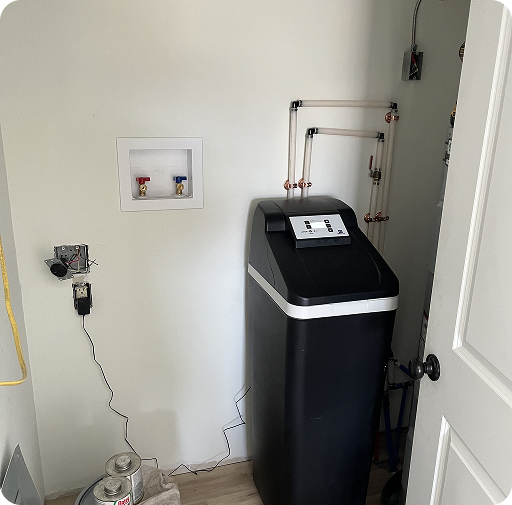
- Site assessment. Your plumber identifies the best installation point — typically where the main water supply enters the home, before it branches to the water heater and throughout the house. The softener needs to be upstream of the water heater to protect it. It also needs proximity to a drain for the regeneration cycle discharge.
- Water shutoff and bypass installation. Water to the home is briefly shut off. A bypass valve is installed so the softener can be taken offline for service without interrupting water supply to the house.
- Unit connection. The softener is plumbed into the supply line. A drain line is run to a floor drain or utility sink for the regeneration discharge. Electrical connection is made if the unit requires it (most modern systems do for the control valve timer).
- System programming and initial salt charge. The control valve is programmed for your household’s water usage and your incoming water hardness. Salt is loaded and the first regeneration cycle is initiated.
- Verification and walkthrough. Your plumber confirms softened water is flowing throughout the home and walks you through the system settings, salt replenishment schedule, and what to watch for.
What you’ll notice right away:
The change in how water feels is often immediate. Soft water has a noticeably different texture — it rinses cleaner, lathers more easily, and doesn’t leave the tight, filmy sensation hard water does. Some homeowners describe it as water that finally “rins es off.” Glassware and shower surfaces will show improvement within a few wash cycles.
The mechanical benefits — reduced scale in pipes and the water heater — accumulate over months and years, not days. Existing scale doesn’t dissolve overnight; the softener prevents new accumulation while the system gradually clears existing deposits over time.
Ongoing Ownership: What It Actually Requires
Water softeners are low-maintenance systems. “Low” doesn’t mean none. Here’s what ownership looks like on a practical basis:
Salt Replenishment
Salt is the only regular consumable. A typical household in the Dayton area — 2 to 4 people on very hard water — uses one 40-pound bag of softener salt roughly every 4 to 6 weeks. Salt costs $6–12 per bag at most hardware and grocery stores. Check the brine tank monthly; keeping it at least one-third full ensures uninterrupted regeneration.
Salt Bridges
A salt bridge is a hardened crust that forms in the brine tank, creating an air gap between the salt and the water below. The system thinks it has salt when it effectively doesn’t, and regeneration becomes ineffective. You’ll notice it when your water starts feeling hard again. Breaking up a salt bridge is straightforward — a long-handled broom or rod pushed through the crust — and using the right salt type (pellets rather than rock salt) significantly reduces the frequency.
Resin Bed Cleaning
The resin bed that does the actual softening work can accumulate iron, sediment, or organic matter over time, particularly in homes with iron in the water supply. A resin cleaner added to the brine tank once or twice a year keeps the bed performing at full capacity. In well water situations with higher iron content, more frequent treatment may be warranted.
Professional Servicing
Most water softeners benefit from a professional inspection every 3 to 5 years. A plumber will check the control valve settings, inspect the resin bed condition, verify bypass valve operation, and confirm the system is sized correctly for current household usage. Resin beds typically last 10 to 15 years before replacement is needed. Control valves and seals may need attention sooner depending on water quality and usage.
One Thing That’s Easy to Get Wrong: Sizing
An undersized softener is one of the most common installation mistakes — and one of the hardest to diagnose afterward, because the system appears to be working while actually failing to keep up with demand. A softener that regenerates too frequently, or that can’t fully treat peak usage periods, won’t deliver the appliance protection it’s supposed to.
Proper sizing is based on three variables: the number of people in the household, daily water consumption, and incoming water hardness. For Dayton municipal water at 200–300 mg/L, most 2 to 4 person households require a 32,000 to 48,000 grain capacity system. Larger households or homes with additional water quality factors may need more. This is not a calculation to guess at — it’s one reason a licensed plumber’s involvement in the selection process matters.
One Question We Get Asked Frequently: Is Softened Water Safe to Drink?
Salt-based softeners add a small amount of sodium to the water — roughly 20–40 milligrams per 8-ounce glass, depending on incoming hardness. For most people, this is nutritionally insignificant and well below any health threshold. The FDA classifies softened water as safe for consumption.
For individuals on sodium-restricted diets or with specific cardiovascular conditions where even small increases in sodium intake are medically relevant, it’s worth a conversation with your doctor. Many households with salt-based softeners also install a dedicated reverse osmosis system at the kitchen sink for drinking and cooking water — which removes sodium along with other dissolved solids. This combination — whole-home softening plus point-of-use RO — is a common setup in the Dayton area.
The Bottom Line for Dayton Homeowners
Hard water at Dayton’s concentration level is not a minor inconvenience. It is an active, ongoing drain on your home’s infrastructure — your water heater, your pipes, your appliances, your fixtures. A properly installed and maintained water softener is one of the most cost-effective protective investments a homeowner in this region can make.
The installation process is straightforward. The ongoing maintenance is minimal. The return — in extended appliance life, reduced energy consumption, lower repair frequency, and daily quality-of-life improvements — begins immediately and compounds over the years.
If you’ve read through this series and you’re ready to move from understanding the problem to solving it, Restoration Plumbing is the call to make.
Ready to Install? Talk to a Licensed Master Plumber First.
Restoration Plumbing is the dedicated plumbing division of RAM Holdings, serving residential and commercial customers throughout the Dayton, Ohio area. We size, supply, and install water softeners and whole-home water treatment systems — and we back the work with the expertise of licensed master plumbers who know the Dayton water profile. All service is performed during standard business hours.
Call us at 937-883-6633 or visit www.restorationplumbing.com to schedule a water softener consultation or installation.
If hard water damage has already led to a plumbing failure or water intrusion event in your home, RAM Restoration — our 24/7 emergency restoration division — is available at 937-885-0088.